

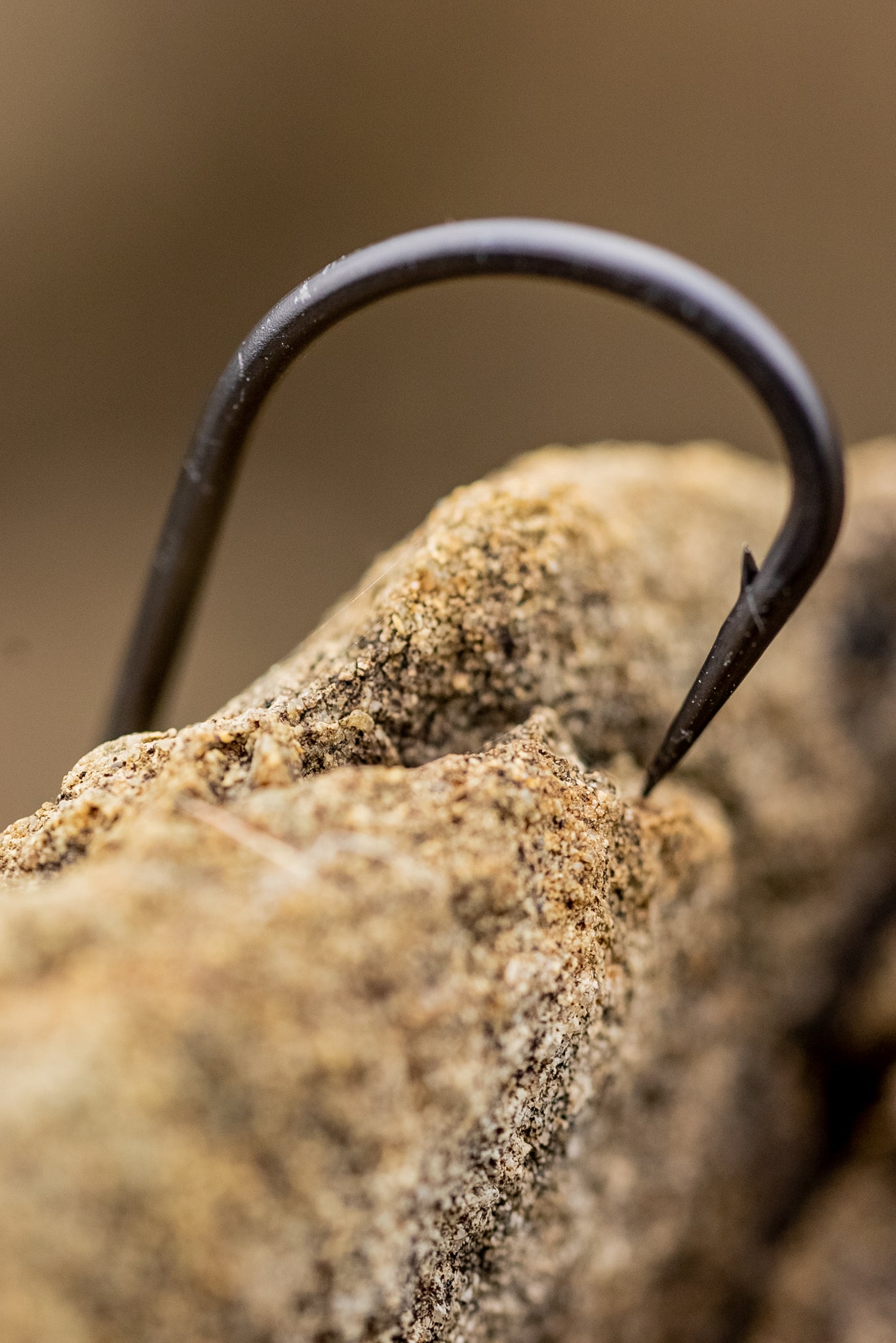
A sharp hook is one of the most important things in carp fishing. This single factor can be the dividing line between landing a big fish or staring into a dry, empty net at the end of your session. In this article, we take a quick look at how to care for, test and sharpen your carp hooks.

"A sharp hook will catch you more fish - simple!"
Checking and testing the sharpness of your hooks is a habit all anglers should practise regularly. If your hook is not pin-sharp, you won’t get as many bites, if any at all, and you significantly increase the risk of losing a fish should you be lucky enough to hook one.
Hooks, no matter how good the quality, can become blunt for a number of reasons. In most carp fishing scenarios, hook points are put under a lot of stress, being dragged across rocky bottoms, gravel, weed and snags, as well as the obvious pressure applied once a fish is hooked.
You should be checking your hooks before every single cast. If a hook is blunt, you either need to sharpen it or replace it, which may even mean tying a completely new rig.
HOW TO TEST YOUR HOOKS
Testing your hooks for sharpness is simple and easy, with anglers commonly using three main methods.
The Nail Test
This is a very common method for testing hook sharpness. Simply press the point of the hook onto your fingernail. If it is sharp, the hook should hold in place with minimal pressure. If the hook is even slightly blunt, it will slide across the nail.

"Testing the point of the hook across the nail is a good method to check sharpness"
The Finger Test
Some anglers believe the flesh of your hands is more representative of a carp’s mouth, so prefer to test hooks directly on their finger. To do this, lightly press the hook point against your skin. If it grips and slightly lifts the flesh, it is sharp. If it pulls away easily with very little force, it needs sharpening.

"Testing the hook sharpness on your finger is a closer match to a carp's mouth"
Take a Close-Up Look
On many occasions, you can tell whether your hook is up to scratch simply by looking at it. Plenty of anglers carry a magnifying glass to inspect their hook points closely, allowing you to clearly see how fine and sharp the point really is.

"Nothing beats a close-up inspection with a magnifying glass"
WHEN TO REPLACE A FISHING HOOK
Even with the best hook sharpening or honing device available, some hooks are simply beyond repair. If the hook point has seriously folded over, you won’t be able to sharpen it effectively without dramatically altering the hook’s performance. In this situation, replacement is the only option.
Using rigs such as the Ronnie/Spinner Rig or the Multi Rig allows you to change hooks quickly and easily without re-tying the entire rig. For quick-changing the hook section on Hinge Stiff Rigs, check out the Dog Bone Ronnie Clips.

HOW TO SHARPEN YOUR CARP FISHING HOOKS
More often than not, even if your hook is not quite as sharp as you’d like—or even totally blunt—it can be recovered and re-cast with a bit of TLC. Our Tweakers Touch Me Up Hook Honing Device has completely changed the game in this regard and has become a true tackle box essential for carp anglers.

"The Touch Me Up is a tackle box essential!"
How to Use the Touch Me Up Hook Honing Device
-
Place the tip of your hook into the top of the Touch Me Up device.
-
Using the handle, twist the device around the hook point.
-
Your hook has now been touched up and is ready to fish.

"Just push the tip of the hook in the top and twist!"
You can use the Touch Me Up as often as required. In fact, if you keep it in your pocket, you can check your rigs before every cast and, if the hook needs it, quickly sharpen it on the bank.

"It's the easiest to use hook sharpening device you'll find"
TOP TIP – Once the top of the Touch Me Up device becomes full of holes, simply trim it down with a Stanley knife to keep it operating at peak performance. This is why the honing block has been designed so long—you can keep it working for ages.
"Watch Ali Hamidi explain how the Touch Me Up works..."
HOOK SHARPENING AFTERCARE
You may notice that after a hook has been touched up, some of the coating has been removed from the point. On shorter sessions, where rods are being recast regularly, this isn’t usually an issue. However, on longer trips—where rigs may be left in the water for over 24 hours—or in particularly harsh water conditions, this can lead to rust.

"If leaving your hooks out for long periods, apply an anti-rust treatment"
NOTE: The Touch Me Up works exceptionally well at restoring rusty hooks too, as shown on our Instagram and Facebook videos.
Fortunately, there are several excellent products available to help prevent rust forming. Our favourite is ZR Hook Treatment. Supplied in a bottle with a brush applicator, simply apply it to the sharpened hook point to prevent corrosion. As an added bonus, it also contains fish attractors.

Journalist Chris Haydon joined the OMC family in spring 2024, after six years working for the UK’s number one fishing publication, Angling Times. He is a keen coarse and carp fishing all-rounder, based in the South West and regularly fishing venues such as the famous Cotswold Water Park.

Share:
How to Catch Carp When It Gets Really Cold: Winter Fishing Tactics
10 Fishing Things to do in 2026